🗓️ Building a 30-Day Emergency Food Supply From Scratch: Options, Dependencies and Planning
A 30-day emergency food supply is enough food to keep your household eating for a month without going to the shops. It sounds like a simple idea — buy more food — but a month changes everything about it. Three days of food fits in a cupboard and needs nothing else. A month of food needs space, water, cooking fuel, a way to keep it fresh, and a household that will actually eat it. This article shows what a month of food really looks like, what it depends on, where most supplies quietly fall short, and how people build one from nothing.
🌪️ Why a Month, and Not a Few Days?
Section titled “🌪️ Why a Month, and Not a Few Days?”Most official advice starts small. The European Union’s preparedness strategy from the mid-2020s set an aim for households across the EU to be able to manage on their own for at least 72 hours, and emergency planning bodies in other regions give similar advice. Three days covers the most common disruptions: a storm, a short power cut, a weekend snowed in.
Real disruptions don’t always stop at three days. When Storm Éowyn hit Ireland in January 2025, nearly 770,000 homes, farms and businesses lost power at its height. Most were reconnected within days — but twelve days later, around 25,000 were still without electricity, and some families waited close to three weeks. Water supplies failed in places too, and in some towns people queued for fuel because filling stations had no power to run their pumps.
That is the gap a 30-day supply is meant to cover. It is for the disruptions that outlast the first wave of help — long regional outages, a winter in a remote area, an illness that keeps everyone at home, a lost job that makes every shop count, or a stretch when the shops are open but the shelves are empty.
📌 Note: A month sits between short-term emergency kits and the much larger stores some people keep for three months or a year. Each step up asks for more space, money and upkeep, and suits some homes far better than others.
🍽️ What a Month of Food Really Looks Like
Section titled “🍽️ What a Month of Food Really Looks Like”A month of food is bigger than most people picture. The easiest way to see it is to count meals rather than days.
One adult eating three meals a day needs around 90 meals in a month, plus drinks and snacks. Two adults need around 180. A family of four needs around 360 — which is roughly the moment most people realise a 30-day supply won’t fit in the spare corner of a kitchen cupboard.
Meals are a rough unit, and real needs vary a great deal with age, body size, health and how active people are. A teenager doing heavy outdoor work in the cold eats far more than a small, inactive adult. For a first plan, though, counting the meals your household already eats gets you surprisingly close.
🏠 An Example: Two Adults in a Small Flat
Section titled “🏠 An Example: Two Adults in a Small Flat”Here is one way a month of food can look for a couple in a small flat. It is an illustration, not a shopping list — but it shows the shape of the thing.
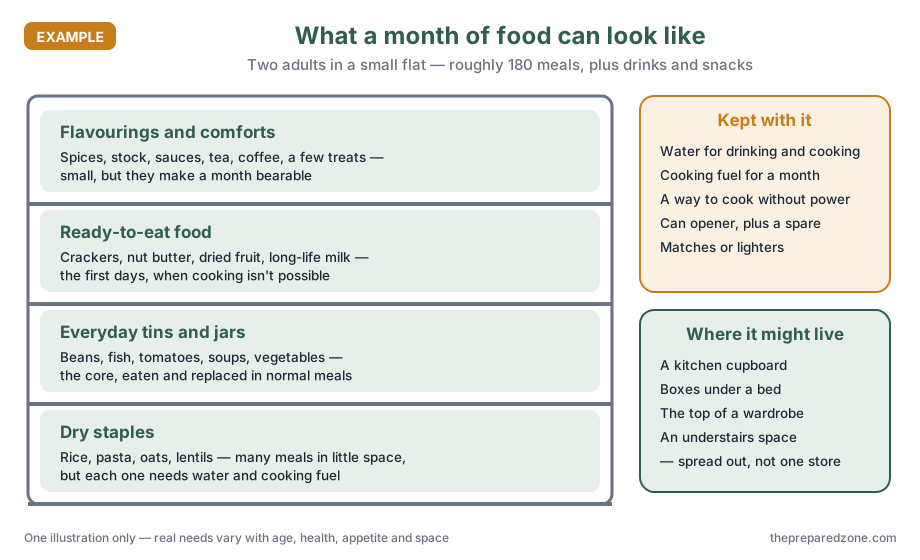
Notice two things. The food is spread across the flat, because no single cupboard holds it. And the box marked “kept with it” matters as much as the shelves — without water, fuel and a tin opener, a good part of that food can’t be eaten at all.
🧱 The Building Blocks of a 30-Day Supply
Section titled “🧱 The Building Blocks of a 30-Day Supply”Almost every month-long supply is built from the same handful of food types. What changes from home to home is the balance between them — and that balance decides how much space the supply takes, how much water and fuel it needs, and how easy it is to keep fresh.
| Food type | Role in a month-long supply | Needs water? | Needs cooking? | Space per meal |
|---|---|---|---|---|
| Everyday tins and jars | The core — familiar, ready to eat, easy to rotate | Rarely | No — can be eaten cold | High |
| Dry staples (rice, pasta, oats, beans, lentils) | The bulk — many meals for little space and money | Yes | Usually | Low |
| Ready-to-eat food (crackers, nut butters, dried fruit, long-life milk) | The first days, and any day cooking isn’t possible | No | No | Medium |
| Freeze-dried and dehydrated meals | A compact back-up where space is tight | Yes | Hot water preferred | Low |
| Flavourings and comforts (spices, stock, sauces, tea, coffee, treats) | Variety and morale over a long stretch | Varies | No | Low |
🥫 Everyday Food Does Most of the Work
Section titled “🥫 Everyday Food Does Most of the Work”The most reliable month-long supplies are built mostly from food you already eat. Familiar food gets eaten and replaced as part of normal meals, so it stays fresh with almost no effort. It is also far easier to face in a stressful week than a bucket of something nobody has tasted. A supply built this way depends on one habit — rotation — more than on any special packaging.
🌾 Dry Staples Fill Out the Month
Section titled “🌾 Dry Staples Fill Out the Month”As a supply grows towards a month, dry staples tend to take over the heavy lifting. Rice, pasta, oats and lentils give the most meals for the least space and money. Their cost is hidden in what they depend on: water to cook them, fuel to cook them for long enough — dried beans especially, which can take a long time unless they are soaked first or pressure-cooked — and airtight, pest-proof storage if they are kept for long.
🍫 The First Few Days Need No Cooking
Section titled “🍫 The First Few Days Need No Cooking”In the first days of a disruption, you may have no power, no time and little appetite for cooking. Ready-to-eat food carries you through that stretch while the fridge and freezer are used up and some kind of cooking arrangement gets sorted out. Many people keep a few days of no-cook food separate from the rest for exactly this reason.
🧂 Variety Is What Gets You to Day Thirty
Section titled “🧂 Variety Is What Gets You to Day Thirty”Over three days, nobody minds eating the same thing. Over a month, monotony becomes a real problem. People faced with the same bland meals day after day often start eating less than they need — sometimes called appetite fatigue — though how much it affects anyone varies from person to person. A jar of spices, a few stock cubes and a bar of chocolate take almost no space and do more to make a month workable than their size suggests.
🔗 What a 30-Day Emergency Food Supply Depends On
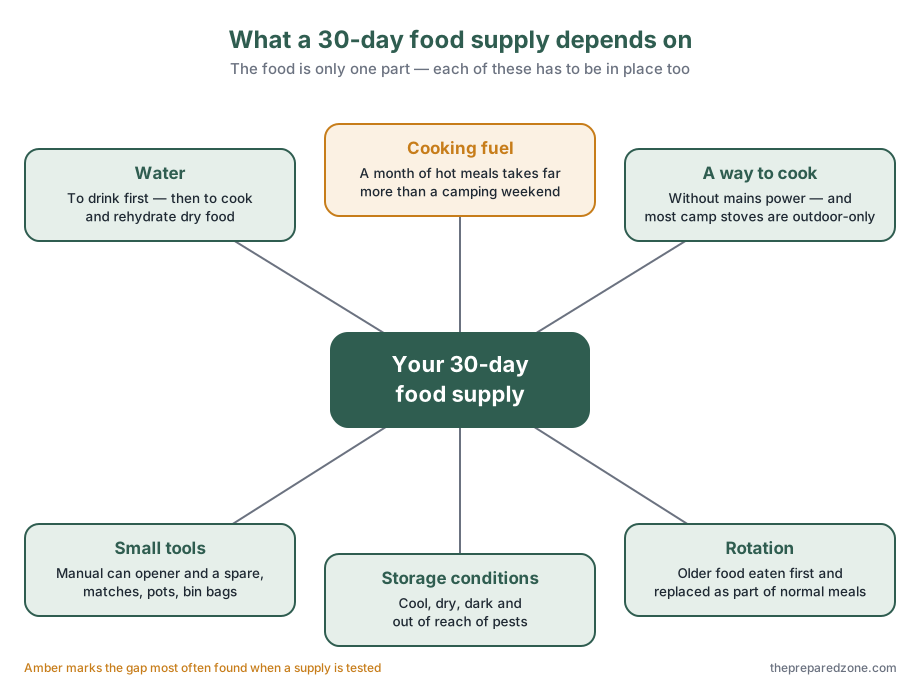
Section titled “🔗 What a 30-Day Emergency Food Supply Depends On”Here is the uncomfortable truth about month-long food supplies: most of them don’t fail for lack of food. They fail on day nine, when the last gas canister runs out and there are still three weeks of rice and lentils on the shelf. Or on day two, when someone realises the only tin opener is electric.
At this size, the things a supply depends on need as much planning as the food itself. Owning something is not the same as being able to use it — the idea behind the Oil Lamp Principle, which runs through every article on this site.
💧 Water Comes First
Section titled “💧 Water Comes First”People need water to drink before anything else — and a 30-day food supply adds to that need. Dry staples and freeze-dried meals need water to cook or rehydrate, and washing up and hand hygiene need it too. A supply weighted towards tins and ready-to-eat food needs much less extra water; one weighted towards dry staples needs a great deal more.
Storing a month of water is a large job in its own right, with its own questions about quantity, containers and safety, and The Prepared Zone covers it separately. The key point here is that food and water belong in the same plan. A shelf of rice without the water to cook it is a shelf of rice you can’t eat.
🔥 Fuel Is Where Most Supplies Fall Short
Section titled “🔥 Fuel Is Where Most Supplies Fall Short”Cooking two hot meals a day for thirty days uses far more fuel than a camping weekend suggests — and fuel is the one part of a supply people rarely test. A handful of gas canisters that feels generous in the cupboard can be gone in little more than a week.
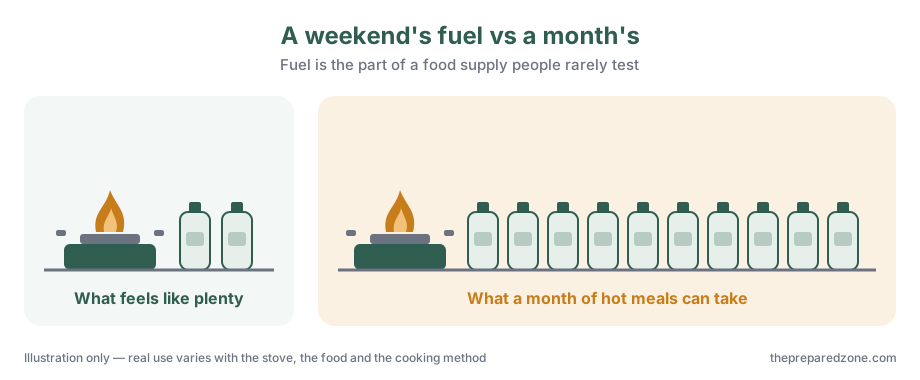
The amount you’d need varies with the stove, the food and the cooking method. Portable gas camping stoves are compact and familiar, but a month of cooking takes a lot of canisters. Homes with a solid-fuel stove or range can often cook on it, depending on fuel and the appliance’s design. Barbecues and outdoor grills work for larger amounts, but only outdoors and in dry weather. And fuel-saving methods — retained-heat cooking, where an insulated container finishes the cooking after the pot comes off the heat, pressure cookers, and one-pot meals — can stretch a month’s fuel much further, each with its own trade-offs. Fuel storage carries safety considerations of its own, which vary by fuel type and are covered elsewhere on the site.
🛒 Gear Pick: For cooking through a month without mains power, look for a stove whose fuel you can store safely in quantity and buy locally, with spare parts available where you live. A stove is only as useful as the fuel stored beside it, so the fuel’s storage needs matter as much as the stove.
🔧 The Small Things Wear Out
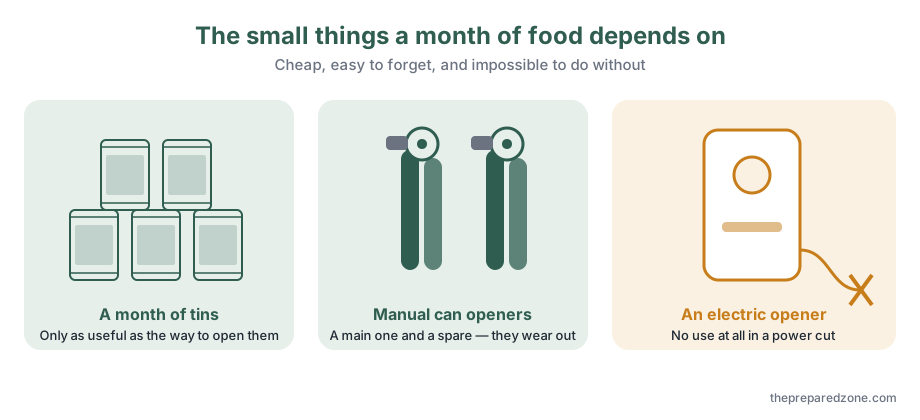
Section titled “🔧 The Small Things Wear Out”A month of eating from a store uses up and wears out small items that a weekend never tests.
This is a starting point, not an exhaustive list — your specific circumstances may involve additional factors worth considering.
- A manual can opener, plus a spare — a month of tins is a lot of opening
- Matches or lighters, kept dry, in quantity
- Pots and pans that work on your cooking setup
- Washing-up supplies, and a way to clean when water is limited
- Bin bags, because waste builds up fast when collection stops
- Enough cutlery, cups and plates, or disposable alternatives
The manual can opener is the item most often missing from food supplies. Many people keep a second one packed with the supply itself, so it stays where it is needed.
🌡️ Where It’s Kept Decides How Long It Lasts
Section titled “🌡️ Where It’s Kept Decides How Long It Lasts”Every part of a 30-day supply lasts longer and stays safer when it is kept cool, dry, dark and away from pests. Heat speeds up the loss of flavour and nutrition. Damp brings mould and rust. Light slowly spoils oils and fats. And mice and insects can get through cardboard and thin plastic.
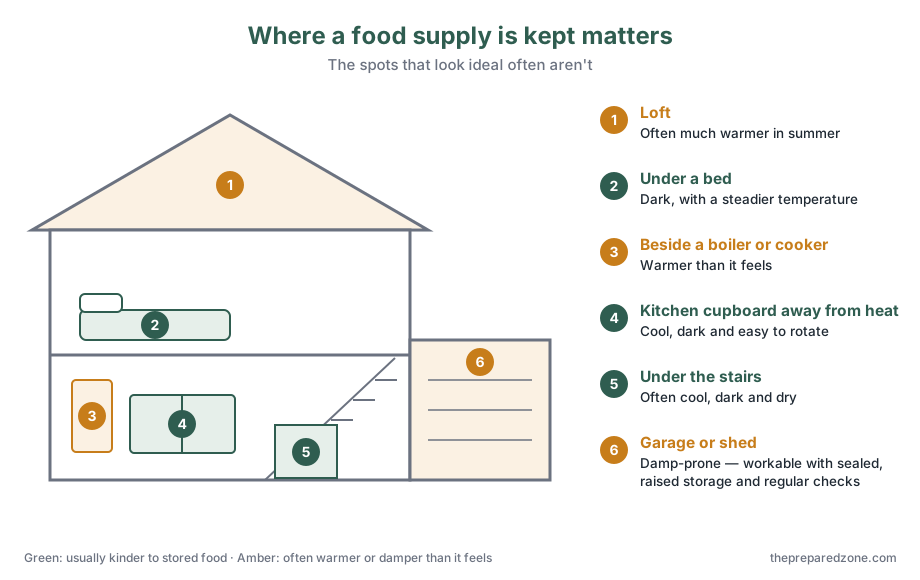
The places that look ideal often aren’t. A loft or garage can be far warmer in summer — and damper in winter — than it feels when you’re standing in it. Where there’s a choice, an interior cupboard, a space under the stairs or boxes under a bed are often better homes.
But for plenty of people there is no choice: a small flat with no spare cupboard, or a house where the shed is the only free space. A shed or garage can still hold a food supply — it just depends on more:
- Sealed, pest-proof containers. Food-grade buckets or tubs with tight-fitting lids keep out damp, insects and mice in a way that cardboard and shop packaging can’t.
- Getting it off the floor. Shelving or pallets keep containers away from cold, damp concrete and make it easier to spot problems.
- Shade and steadier temperatures. A spot away from the sunny wall, out of direct sun through a window, and away from a metal roof that heats up in summer.
- Foods that cope better with swings. Dry staples sealed in buckets tend to tolerate a shed better than tins, which can rust in damp air — as long as the food goes in dry and properly packaged. A bucket on its own doesn’t make food immune to heat, damp or pests.
- Keeping it apart from fuel and chemicals. Petrol, paint, garden chemicals and pest bait often live in sheds too, and food is better stored well away from them.
- More frequent checks. A shed supply needs looking at more often than one in the house — for damp, rust, pests and damaged packaging.
None of this makes a shed as kind to food as a cool cupboard indoors, but it closes much of the gap. Containers, shelving and cool storage without a fridge each have their own articles on the site.
🔄 Rotation Keeps It Alive
Section titled “🔄 Rotation Keeps It Alive”A supply bought in one go and left alone ages all at once. Rotation is what stops that: food from the store is eaten as part of normal meals, oldest first, and replaced with new stock at the back.
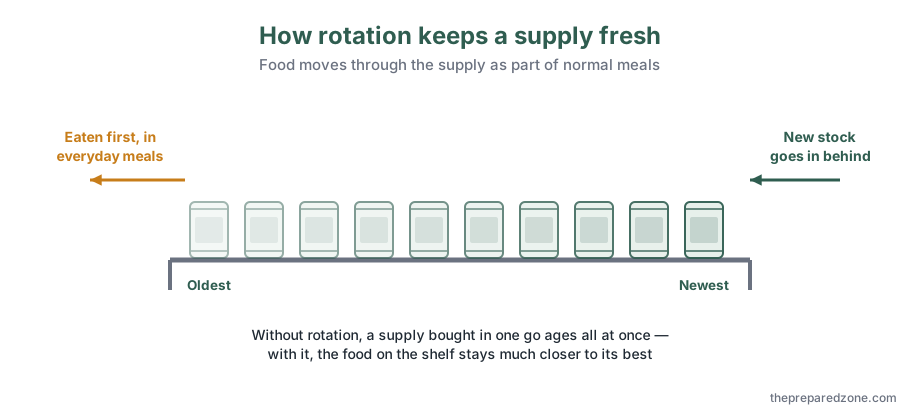
At 30 days, the supply is large enough that rotation needs some kind of system — a written list, a date on each item, or a firm habit that new stock goes behind old. None of them is complicated. The one that works is the one that actually happens.
⚠️ Warning: Date labels do not all mean the same thing. In the European Union, the UK and Ireland, a “use by” date relates to safety and a “best before” date relates to quality; other countries use different systems. Your national food safety authority — the Food Safety Authority of Ireland, the Food Standards Agency in the UK, the USDA’s food safety service in the US, or the equivalent body in your country — publishes guidance on date labels. Search “[your country] + food safety authority” to find the current body in your region.
🪜 How a 30-Day Emergency Food Supply Comes Together
Section titled “🪜 How a 30-Day Emergency Food Supply Comes Together”Very few people buy a month of food in one trip. Most build it over weeks or months, in a way that fits their budget and space — and gives the habits time to settle in.
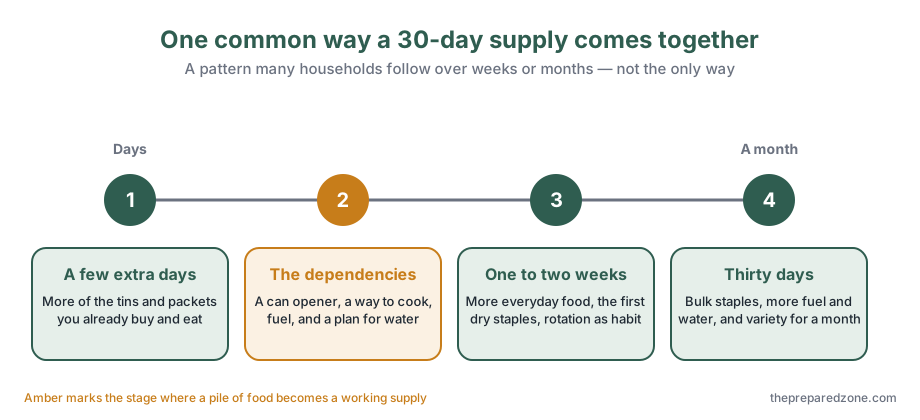
The second stage is the one people skip — and it is the most important. Up to that point you have a pile of food. After it, you have a supply that works when the power is off. Adding the can opener, the stove, the fuel and a plan for water before the food store grows much further means every extra week of food is a week you can actually eat.
Adding a few extra items to each normal shop is a common way to build up without a large one-off cost. Buying in bulk can lower the cost per meal, but it only pays off if the food is stored well and eaten before it declines.
💡 Tip: The quickest way to find the gaps in a supply is to live off it for a weekend. People who try it usually find something they hadn’t noticed — the tin opener in the wrong box, the gas running lower than expected, or a stack of food that nobody actually wants to eat.
🧩 Fitting It to the People in Your Home
Section titled “🧩 Fitting It to the People in Your Home”A month-long supply only works if everyone it is meant for can eat it for a month. Babies, older people, anyone with serious food allergies or coeliac disease, people managing diabetes or other diet-related conditions, vegetarians and vegans — and pets — all have needs that a general supply may not meet. Each has its own article on the site.
⚠️ Warning: Where someone’s health depends on what they eat — including infants, people with serious allergies, and people managing medical conditions through diet — a month-long supply needs to be planned around their specific needs. A registered dietitian, family doctor, public health nurse or specialist team can advise on what is suitable. Search “[your country] + registered dietitian” to find a qualified professional in your region.
🚫 Where 30-Day Supplies Go Wrong
Section titled “🚫 Where 30-Day Supplies Go Wrong”Some problems only show up at the scale of a month.
Plenty of food, not enough fuel. A month of rice, pasta and beans with a weekend’s worth of gas is the most common gap of all.
Plenty of food, not enough water. Dry and freeze-dried food can quietly need more water than the household has stored.
A month of the same three meals. People eat less than they need when every meal is the same, even with food on the shelf.
Bought once, never touched. A supply bought in a single trip ages all at once, and large parts of it can pass their best together.
Stored somewhere that looks ideal. Warm lofts and damp garages shorten the life of a month’s food and invite pests.
All in one place. A single store can be lost to a flood, a fire or an evacuation. Some people keep a small part of their supply somewhere else.
Cooking with outdoor equipment indoors. Using a camping stove or barbecue inside during a long power cut is a well-known cause of carbon monoxide poisoning (see the warning above).
🖨️ Free printable: What your food supply depends on (PDF) — a two-page planning sheet for spotting these gaps in your own home, with space to note what a weekend test turns up.
🤝 Where to Go Next
Section titled “🤝 Where to Go Next”A 30-day food supply touches food safety, health, fuel safety and household planning. These are the kinds of organisations that can help with the next step:
Your national emergency planning body publishes household preparedness guidance for your country — in Ireland, the Office of Emergency Planning’s Be Emergency Ready campaign; in the US, the Federal Emergency Management Agency’s Ready programme; in the UK, the government’s emergency preparedness guidance; or the equivalent body in your country. Search “[your country] + emergency preparedness” to find the current guidance in your region.
Your national food safety authority (see above) publishes guidance on date labels, damaged tins and food safety during power cuts.
A registered dietitian, family doctor or specialist team (see above) can advise where someone’s health depends on their diet.
Your national fire service or gas safety body (see above) publishes guidance on carbon monoxide and the safe use and storage of cooking fuels.
Your local authority or council often runs community resilience programmes and can tell you about local risks and the support available in your area during emergencies.
❓ Frequently Asked Questions
Section titled “❓ Frequently Asked Questions”Q: How much food is in a 30-day emergency food supply? A: Roughly three meals a day per person for a month — around 90 meals for one adult, around 180 for two, and around 360 for a family of four — plus drinks and snacks. That is a planning estimate; real needs vary with age, body size, health and activity.
Q: Is a 30-day food supply more than governments recommend? A: In most countries, yes. Official guidance often starts at about three days as a baseline, which covers the most common short disruptions. Events like Storm Éowyn in Ireland, where some homes were without power for well over a week, are why some people choose to plan for longer.
Q: What is the cheapest way to build a one-month food supply? A: Many people build it gradually, adding a few extra items to each normal shop, which spreads the cost and keeps the food familiar. Dry staples give the most meals for the money, but they depend on water and cooking fuel — so the cheapest food is not always the cheapest supply once everything it needs is counted.
Q: How long does it take to build a 30-day food supply from scratch? A: It depends on budget and space. Some people reach a month within a few weeks; many take several months, adding food and the things it depends on in stages. A supply built slowly often works better, because the rotation habit has time to settle in.
Q: Do I need special long-term storage food for a 30-day supply? A: Not necessarily. Many 30-day supplies are built mainly from everyday tins, packets and dry staples that the household already eats, kept fresh by rotation. Specialist freeze-dried or long-life food can save space, but costs more per meal and depends on water to prepare.
Q: Where can a 30-day food supply be stored in a small home? A: Usually in several places rather than one — a kitchen cupboard, boxes under a bed, the top of a wardrobe, an understairs space. Cool, dry, dark spots away from pests keep food longest; lofts and garages are often warmer or damper than they seem.
💭 Final Thoughts
Section titled “💭 Final Thoughts”Somewhere around the second week of building a 30-day supply, the project stops being about food. The shelves are filling, but the real questions have moved on: how much gas is really in the cupboard, where the water would come from, whether anyone in the house would eat lentils four nights running.
That shift is the point. A month of food is a test of everything around it — the fuel, the water, the tin opener, the habits — and building one tends to show you exactly where your home’s weak spots are. Many people set out to stock a pantry and end up with something more useful: a clear, honest picture of how their household would cope if the ordinary flow of things stopped for a while.
© 2026 The Prepared Zone. All rights reserved. Original article: https://www.thepreparedzone.com/food-nutrition/food-storage-principles-and-planning/how-to-build-a-30-day-emergency-food-supply-from-scratch/